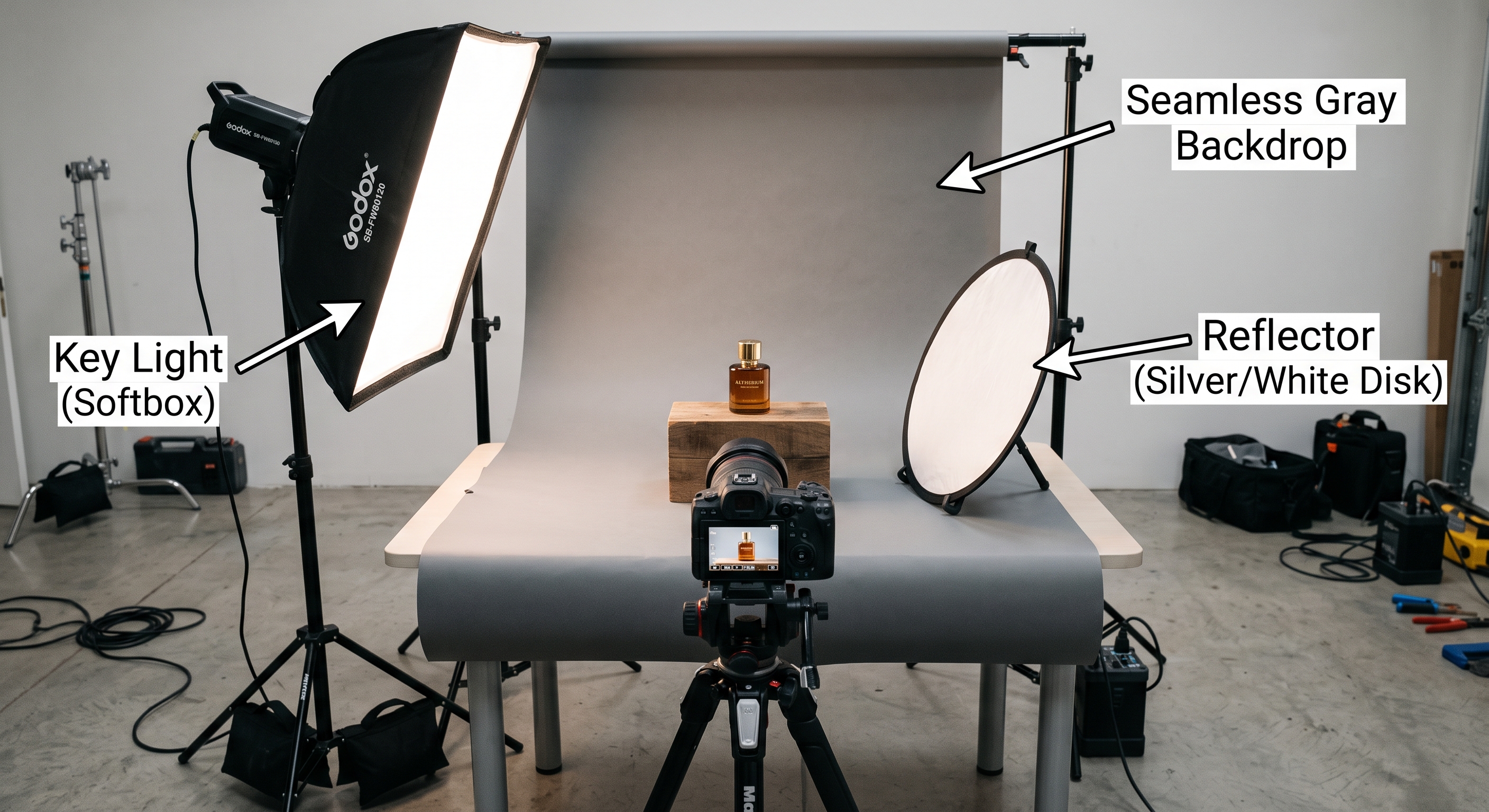
Product photography has its own vocabulary, and when you're just starting out, tutorials and camera settings can feel like they're written in another language. The good news is that you only need to understand a handful of terms to shoot great product photos and follow almost any guide. Here are the eight most useful ones, explained in plain English, with an explanation of why each one matters for selling online.
Quick answer: The essential product photography terms every beginner should know are white balance (color accuracy), exposure (brightness), diffused light (soft, even light), a reflector (to fill shadows), depth of field (how much is in focus), flat lay (a top-down shot), a sweep (a seamless curved backdrop), and resolution (image size and sharpness).
1. White balance
White balance is the setting that keeps colours accurate, so whites look truly white instead of orange (too warm) or blue (too cool). It matters more than almost any other setting in product photography, because your product's real colour is what buyers expect to receive. Getting white balance right prevents returns and bad reviews caused by "the colour looked different online."
2. Exposure
Exposure is how bright or dark the photo is. An underexposed photo looks dim and muddy; an overexposed one loses detail in the bright areas. Product photos usually look best slightly bright and airy. On a phone, you can adjust exposure by tapping to focus and then sliding the little sun icon up or down.
3. Diffused (soft) light
Diffused light is soft, even light with no harsh edges - the opposite of hard, direct light that creates sharp shadows and bright hotspots. It's the single biggest factor in whether a photo looks professional. The light on an overcast day is naturally diffused, and you can soften harsh light indoors with a thin curtain or a sheet of white paper over the window.
4. Reflector
A reflector is anything that bounces light back onto the shadow side of your product to soften shadows and even out the lighting. It doesn't need to be special equipment - a piece of white foam board, white card, or even a folded white sheet works. Placed opposite your light source, it fills in the dark side and gives a balanced, professional look for free.
5. Depth of field
Depth of field is how much of the image is in sharp focus, from front to back. A shallow depth of field keeps the product sharp while blurring the background (the soft, out-of-focus look); a deep depth of field keeps everything sharp. For most product photos, you want the entire product in focus, so buyers can see every detail clearly.
6. Flat lay
A flat lay is a photo taken from directly above, looking straight down at products arranged on a surface. It's a popular, styled look for items like jewellery, stationery, cosmetics, and clothing, and it works especially well for lifestyle and social media images. All you need is a way to hold the camera level above the scene.
7. Sweep (seamless background)
A sweep - also called a seamless - is a single sheet of paper or fabric that curves smoothly from vertical to horizontal with no visible corner, creating a clean, infinite-looking background. It's how you get that seamless white (or colored) backdrop at home without a studio. Curving the paper instead of bending it at a sharp angle is what removes the horizon line.
8. Resolution
Resolution refers to an image's pixel dimensions — how much detail it contains. Higher resolution means a sharper image and the ability to zoom in without it looking blurry. Aim for at least 2,000 pixels on the shortest side (a 2,048 × 2,048 square is a safe target), which keeps images crisp and enables zoom on most selling platforms. Ignore "DPI" for web images; only the pixel dimensions matter.
TIP: If you only master two of these first, make them white balance and diffused light. Accurate colour plus soft, even lighting fix the majority of amateur-looking product photos on their own.
Once you understand these basics, you'll have a much easier time shooting a clean source photo - and an AI product photography tool can take that photo the rest of the way.
Turn a clean product photo into polished, studio-quality images in seconds.
Try Easy Content Studio free
Frequently asked questions
What are the most important product photography terms for beginners?
The essentials are white balance, exposure, diffused light, reflector, depth of field, flat lay, sweep, and resolution. Together they cover colour accuracy, brightness, lighting, focus, composition, and image quality - enough to follow most tutorials and use your camera confidently.
What is white balance in product photography?
White balance is the setting that keeps colours accurate so whites look white rather than orange or blue. Correct white balance ensures your product's real colour is what buyers see, which reduces returns and builds trust.
What is a flat lay?
A flat lay is a photo taken from directly above, looking straight down at products arranged on a surface. It's popular for styled, editorial-looking shots of items like jewellery, stationery, and clothing, and works well for lifestyle and social images.
What is a sweep in product photography?
A sweep (or seamless) is a single curved sheet of paper or fabric that goes from vertical to horizontal without a visible corner, creating a smooth, infinite-looking background. It's how you get a clean, seamless white or colored backdrop at home.
What does depth of field mean?
Depth of field is how much of the image is in sharp focus. A shallow depth of field blurs the background to isolate the product; a deep depth of field keeps everything sharp. For most product photos, you want the whole product in focus.
What resolution should product photos be?
Aim for at least 2,000 pixels on the shortest side (2,048 × 2,048 square is a safe target) so images look sharp and support zoom on most platforms. Resolution refers to pixel dimensions; higher resolution means more detail for buyers to inspect.
Do you need to know technical terms to take good product photos?
Not many. Understanding a handful - white balance, exposure, diffused light, and resolution - covers most of what affects a product photo. The rest you can pick up as you go; good lighting and a clean setup matter more than jargon.