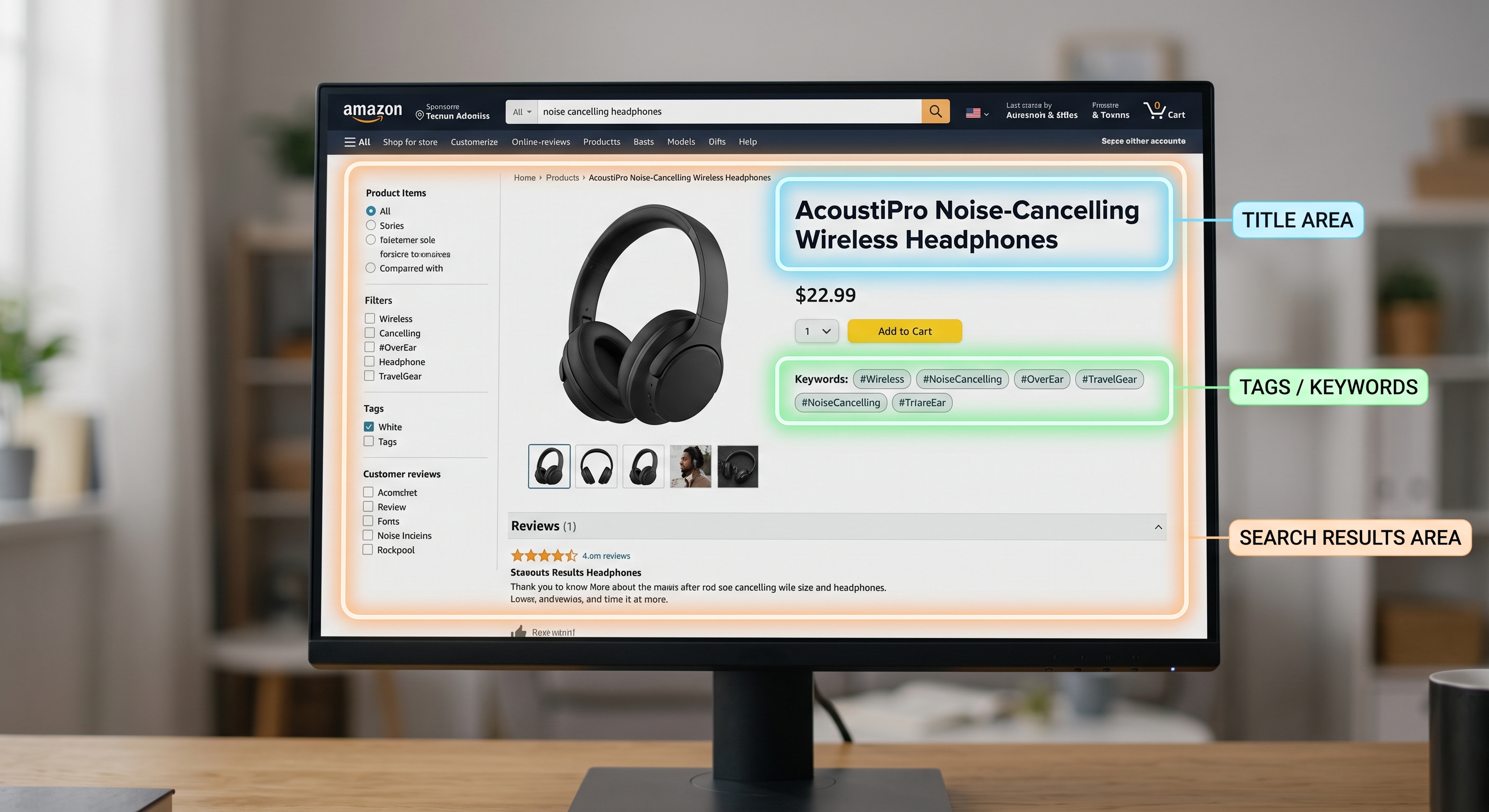
You can have the best product in your category, but if it doesn't show up when buyers search, it won't sell. Getting found is its own skill - product listing SEO - and it's often the difference between a shop that grows and one that stalls. The good news is that the fundamentals are the same across Etsy, Amazon, and Google, and none of them requires tricks. This guide explains how marketplace search actually works and how to optimise your listings to rank higher and reach more buyers.
Quick answer: Product listing SEO means optimising your titles, tags, and content so marketplaces show your product to the right buyers. Put the exact keywords buyers search for into your title and tags, fill in every field and attribute, use clear, high-quality photos, price competitively, and earn good reviews. Platforms rank listings that both match the search and convert well.
What is product listing SEO?
Product listing SEO is the practice of optimising a product listing so it appears higher in a marketplace's search results for the terms buyers actually type. It's the marketplace equivalent of ranking on Google: the better your listing matches a search and the more reliably it turns views into sales, the more the platform shows it. Every marketplace wants to put listings in front of buyers that are both relevant and likely to sell, so your job is to prove your listing is both.
How do marketplace search algorithms work?
Nearly every marketplace search does two things in order. First, relevance: it finds listings whose title, tags, categories, and attributes match the buyer's search. If your keywords aren't there, you don't even enter the running. Second, ranking by quality: among the matches, it ranks the ones most likely to sell higher, based on signals like click-through rate, add-to-cart rate, conversion rate, and reviews.
In 2026, both marketplaces have leaned further into understanding intent rather than just matching exact words, so the meaning and context of your listing matter, not only the literal keywords. But the core stays the same: match the search, then convert the click.
How do you find the right keywords?
Keyword research is the foundation everything else builds on. The goal is to describe your product using the words buyers actually search, not the words you'd use internally:
- Think like a buyer. Search for your own product and see what autocompletes and what competitors rank for.
- Favor specific, long-tail phrases. "Silver moon necklace" reaches a ready-to-buy searcher; "necklace" competes with millions and converts worse.
- Cover different angles - material, style, use case, occasion, recipient - since buyers search in many ways.
- Use a keyword tool built for your platform to see real search terms and demand.
How do you write a listing title that ranks?
Your title carries the most weight in search, so it has to work hard while staying readable:
- Front-load your most important keyword. Put the phrase a buyer is most likely to search for at the very start.
- On Etsy, keep it readable. The 2026 algorithm penalises titles that look like a string of stuffed tags. Use commas or pipes to separate a few clear phrases.
- On Amazon, be information-dense but concise. Include brand, material, and primary use, but note Amazon now favours shorter titles (around 75 characters) and can rewrite ones that run long.
- Lead with what matters - the first words are what buyers see in a truncated mobile view.
How do you use tags, categories, and attributes?
These are how the platform understands what you sell, so fill them all in:
- Use every tag slot. On Etsy, you get 13 tags; every empty one is a missed chance to rank. Each tag can hold a descriptive compound phrase (the character limit is generous), so use phrases, not single words.
- Don't duplicate your title in your tags. The platform already reads your title. Use your tags to cover lateral keywords - related terms and synonyms that aren't in the title - to widen your reach.
- Use singular terms where the platform matches singular and plural automatically, to leave room for more modifiers.
- Complete every category and attribute (size, colour, material). Attributes both help matching and let you rank for those specific filters.
TIP: The most common tagging mistake is repeating your title keywords in your tags. It wastes slots. Treat your title and tags as covering different keyword territory, so together they match as many relevant searches as possible.
Do photos affect search ranking?
Yes - more than most sellers realise, in two ways. First, indirectly but powerfully: your main image drives click-through rate, and clicks and conversions are among the biggest ranking signals. A weak thumbnail means fewer clicks, which the algorithm reads as low relevance. Second, directly: marketplace and web search increasingly use computer vision to "see" what's in your images, so a clear main image that accurately represents the product helps, and descriptive image alt text (where available) gives the algorithm extra context.
In other words, great photos aren't just for buyers - they feed the ranking system that decides who sees your listing at all.
Turn a plain product photo into the clean, high-converting images that lift click-through and ranking.
Try Easy Content Studio free
Does the product description affect SEO?
It depends on where. On Etsy, descriptions are not a primary factor for internal search matching - titles and tags do that work - but they still matter because they affect your Google ranking and they drive the conversion rate that Etsy's algorithm rewards. On Amazon, the description is indexed for search. Either way, include your keywords naturally in the first paragraph, and write the rest to convert.
NOTE: Descriptions don't rank you on Etsy the way titles and tags do, but don't neglect them. They influence Google, and they influence whether a visitor buys - and conversion rate is one of the strongest ranking signals there is.
What else affects your ranking?
Search is only half the picture; the platform also weighs how well your whole shop performs:
- Conversion and engagement - click-through, add-to-cart, and purchase rates relative to impressions.
- Reviews and shop quality - strong reviews, seller status, and reliable service.
- Shipping and price - competitive pricing and shipping are buyer-experience signals.
- Recency - new and recently renewed listings often get a temporary boost.
- Listing completeness - clean, complete data ("listing hygiene") is itself a ranking signal in 2026.
Individual listing SEO can't overcome poor reviews or slow service, so the shop-level basics matter as much as the keywords.
How is listing SEO different on Etsy, Amazon, and your own store?
The principles are shared, but the emphasis differs:
- Etsy - evocative, readable titles; all 13 tags with lateral keywords; strong reliance on relevance plus conversion and Star Seller-style trust signals.
- Amazon - information-dense but concise titles, keyword-rich bullets, backend search terms, and heavy weight on sales performance and reviews.
- Your own store (Shopify and similar) - you're optimising for Google, so page titles, headings, URLs, image alt text, unique descriptions, and site speed do the work.
How long does listing SEO take to work?
Usually one to three months, depending on your competition, listing quality, and shop activity. SEO is a compounding investment rather than an instant switch: as your listings accumulate clicks, favourites, and sales, the algorithm trusts them more and ranks them higher, which brings more of the same. Optimise once, keep your quality high, and the results build over time.
Frequently asked questions
What is product listing SEO?
It's optimising a product listing so it ranks higher in a marketplace's search results for the terms buyers search. It combines relevance (matching keywords in your title, tags, and attributes) with quality signals (click-through and conversion rates, reviews) that show the platform your listing is worth showing.
What is the most important part of a listing for SEO?
Your title carries the most weight for search matching, so it should lead with your most important keyword. After that, tags, complete attributes, high-quality photos that drive clicks, and a strong conversion rate are what push a listing up the rankings.
Do photos affect search ranking?
Yes. Your main image drives click-through rate, and clicks and conversions are major ranking signals, so a stronger thumbnail ranks better. Search systems also increasingly analyse image content directly, so a clear, accurate main image and descriptive alt text help too.
How many tags should you use on Etsy?
Use all 13. Every empty slot is a missed chance to match a search. Fill them with descriptive compound phrases rather than single words, and use them for related "lateral" keywords instead of repeating the words already in your title.
Does the product description help SEO?
On Etsy, it isn't a primary internal search factor, but it affects your Google ranking and your conversion rate, both of which matter. On Amazon and your own store, the description is indexed and does contribute directly. Include keywords naturally in the first paragraph everywhere.
How long does it take to rank on Etsy or Amazon?
Typically one to three months, depending on competition, listing quality, and shop activity. Ranking builds as your listings accumulate clicks and sales, so consistent optimisation and good conversion compound over time rather than working instantly.