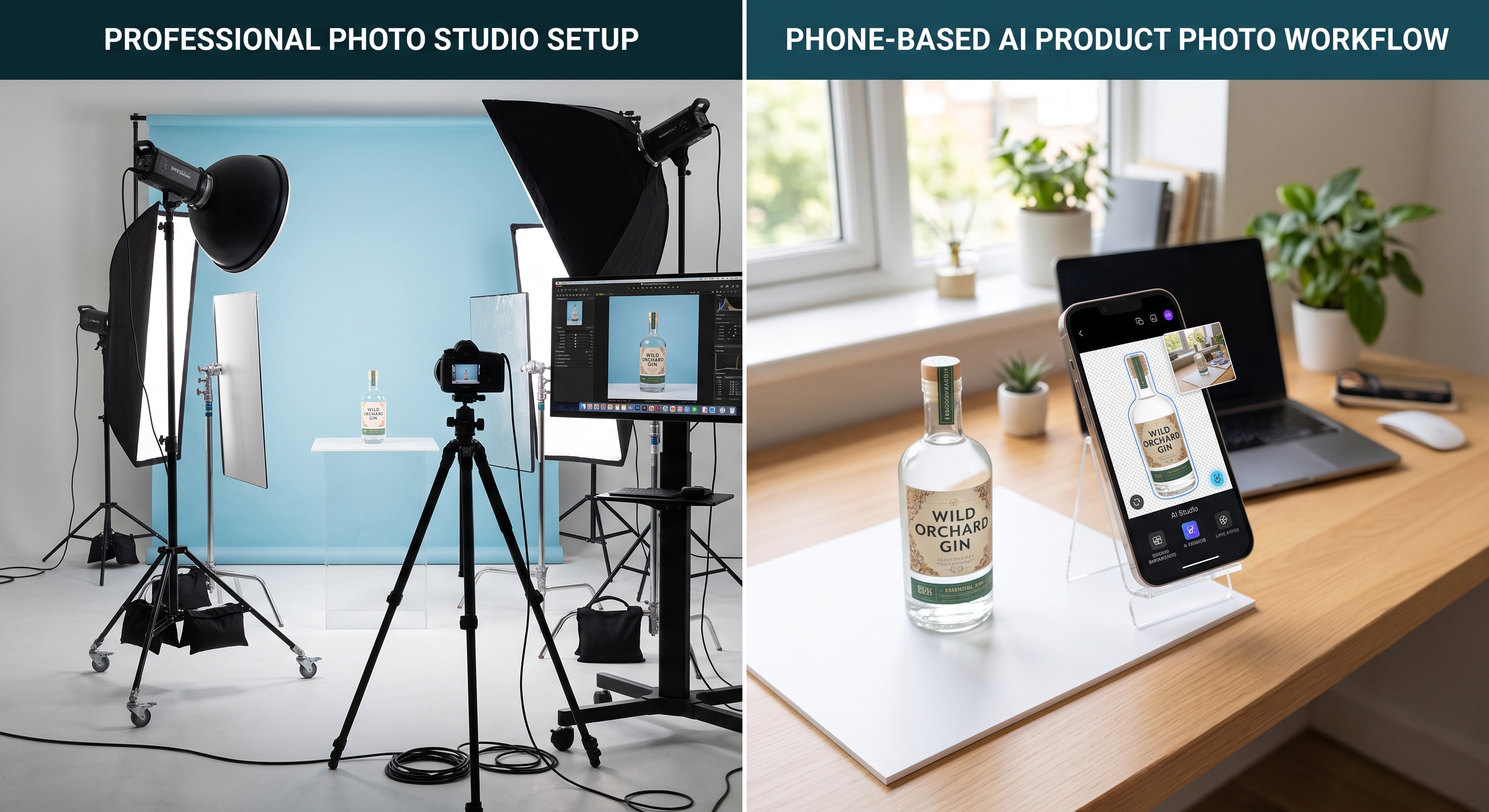
For years, sellers had two options for product photos: hire a professional photographer or shoot them yourself. Today there's a real third option - AI product photography that turns a single phone photo into polished, studio-style imagery. But cheaper and faster isn't automatically better for every product. The right choice depends on what you sell, how big your catalogue is, your budget, and where you list. Here's an honest comparison to help you decide.
Quick answer: AI product photography is dramatically cheaper and faster than hiring a photographer, and its subscription pricing scales especially well for large catalogues. A professional photographer still wins for luxury, highly reflective, or editorial work where perfect colour and texture matter most. For most everyday e-commerce listings, AI now covers the job.
How does hiring a product photographer work?
Professional product photography is usually priced per image, per day, or per project - and the headline rate is rarely the full cost. On top of it come the extras: retouching, studio rental, shipping your products to and from the photographer, props, styling, and the coordination around a shoot. Styled and lifestyle images, which need props or models, cost considerably more than plain white-background shots. Most importantly, the cost scales with your catalogue - every additional product is another set of images to pay for - so the total climbs steadily as your range grows.
How does AI product photography pricing work?
AI product photography runs on a completely different model. Instead of paying per shoot, you upload a photo you already have and generate images from it under a monthly subscription. Plans are typically sized by how many images you can generate each month, so you choose the tier that fits your volume. Within a plan, there are no per-shoot or reshoot fees, and trying different lifestyle scenes or backgrounds doesn't add a charge - though each generated image counts toward your monthly allowance. You're paying one predictable monthly fee for a set batch of images, and if you outgrow a plan you move up to a larger one. Compared with paying per product, that stays far more predictable and cost-effective as your catalogue grows.
Which produces better quality?
This is where the honest answer matters. The quality gap has narrowed dramatically - for most standard listing images and lifestyle scenes, good AI output is genuinely hard to distinguish from a studio shoot. But professionals still have a real edge in specific cases:
- Highly reflective, transparent, or metallic products (glassware, jewellery, chrome) where light behaviour is complex.
- Texture-critical items where the exact feel of a material matters.
- Luxury and editorial imagery where perfect colour accuracy and art direction justify the cost.
AI can occasionally struggle with exact colour matching and fine texture, which is why the source photo you feed it matters so much - and why every generated image should be reviewed before publishing.
Which is faster?
AI wins decisively. A professional shoot means scheduling, shipping products, the shoot itself, and days of editing - often weeks from start to finish. AI generates images in a tiny fraction of that time, so you can list a new product the same day you photograph it. For sellers who add products frequently or need to move fast on a launch, that speed is often the deciding factor.
Which gives you more control and consistency?
They offer different kinds of control. AI lets you iterate quickly - regenerate a background, try a new scene, or restyle an image without booking a reshoot - and it makes catalogue-wide consistency easy, since you can apply the same look across every product. A photographer offers creative direction and hands-on art direction that's valuable for campaigns, but reshoots and changes cost real time and money.
TIP: Match your photography spend to your product margin. A high-margin signature product can easily justify the cost of a professional shoot; a low-margin, high-volume catalogue item usually can't. High-margin hero products are where a photographer earns their fee - everyday catalogue items are where AI's economics win.
When should you hire a professional photographer?
A professional is the better choice when:
- You sell luxury or high-margin hero products where perceived quality drives the sale.
- You need editorial or campaign imagery with real art direction.
- Your products are highly reflective, transparent, or texture-critical.
- You're shooting a small number of signature items where the cost per image is easy to absorb.
When is AI the better choice?
AI tends to win when:
- You have a **large or growing catalogue ** where per-shoot costs add up fast.
- You're working with a tight budget or unpredictable cash flow.
- You need fast turnaround and add new products regularly.
- You want consistent imagery across every listing.
- You want lifestyle scenes without building sets or hiring models.
Can you use both together?
Yes - and many brands do. A common approach is a hybrid: photograph your hero products or complex items professionally, then use AI to generate variations, background swaps, lifestyle scenes, and format adaptations across the rest of the catalogue. This keeps the quality where it matters most while cutting overall production costs substantially.
A polished catalogue doesn't have to mean a studio budget.
Turn a single product photo into clean, studio-quality e-commerce imagery in seconds.
Try Easy Content Studio for free
Frequently asked questions
Is AI product photography cheaper than hiring a photographer?
Yes, and usually by a wide margin, especially at scale. A photographer charges per image or per shoot, with added costs for retouching, studio, shipping, and coordination, and the total grows with every product you add. AI tools are subscription-based, giving you a set batch of images for a predictable monthly fee, so at any real catalogue size the cost per image works out far lower.
Is AI product photography as good as a professional photographer?
For most standard listing and lifestyle images, the quality gap has narrowed a lot, and AI is often good enough. Professionals still have the edge for luxury, editorial, and highly reflective or transparent products where perfect colour and texture are critical.
How is professional product photography priced?
Typically per image, per day, or per project - but the headline rate isn't the whole cost. Retouching, studio rental, shipping products, props, and coordination all add to it, and because you pay per product, the total scales with the size of your catalogue.
How is AI product photography priced?
Typically as a monthly subscription that includes a set number of image generations. You choose a plan that fits your volume, and within it there are no per-shoot or reshoot fees; if you need more, you move up to a larger plan. For one predictable monthly fee, you get a batch of images, which is far more cost-effective than commissioning individual shoots.
Can you use AI product photos on Amazon?
Amazon can flag AI-generated main images, and its main image must be a pure white background, so AI is safest for secondary and lifestyle slots or when the main image clearly meets Amazon's rules. Always review AI output for accurate colour and texture before publishing.
When should you hire a professional photographer instead of using AI?
When you sell luxury or high-margin hero products, need editorial or campaign imagery, or shoot highly reflective, transparent, or texture-critical items where perfect accuracy matters. Matching photography spend to product margin is the key judgment.
Can you combine AI and professional photography?
Yes, and many brands do. A common approach is to shoot hero or complex products professionally, then use AI to generate variations, backgrounds, lifestyle scenes, and format adaptations across the rest of the catalogue — cutting overall costs substantially.